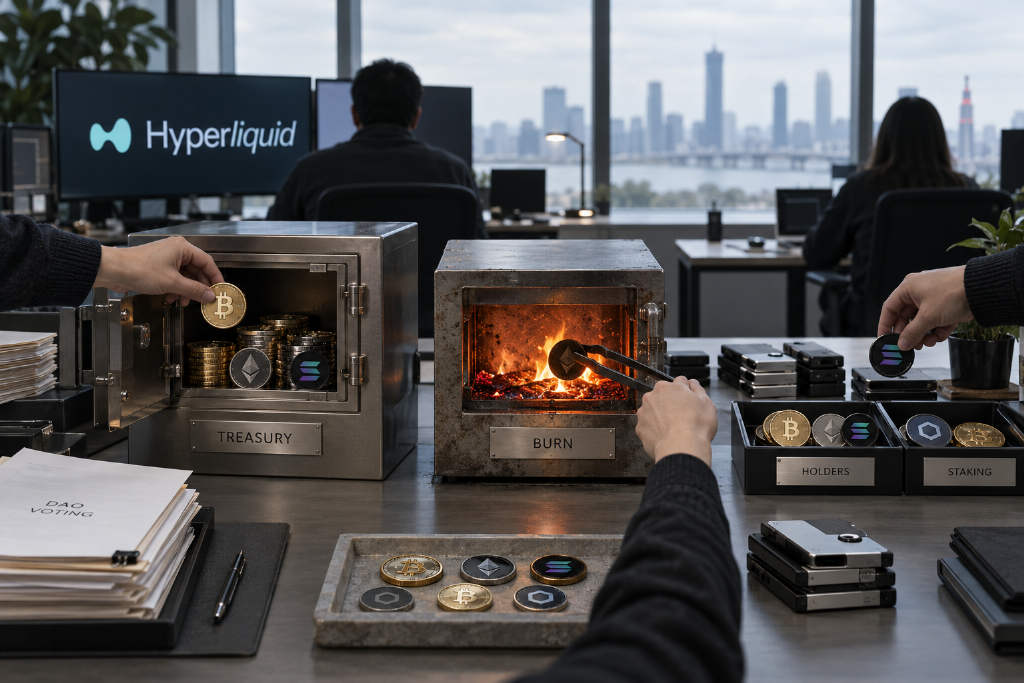
token buyback2026-10-02 10:40:0815 crypto apps compared by buybacks and token payoutsA growing number of crypto projects are tying protocol income more directly to token value capture, but the mechanics vary sharply even when teams use the same labels. MarsBit reviewed 15 projects and compared how they generate income, what share of fees or revenue goes to buybacks, whether purchased tokens are burned, and whether holders receive any direct distribution. The list includes Hyperliquid, Pump.fun, Uniswap, Sky, Aave, Jupiter, Ethena, Morpho, Pons, PancakeSwap, Pendle, Raydium, ether.fi and Aster. Some models send nearly all designated fees into automated buybacks and permanent burns. Others route purchased tokens into treasury reserves or long-term lockups. In several cases, token holders only benefit indirectly, while stakers under separate programs receive the actual distribution. The article also draws a line between fees and revenue. High fee volume does not mean a protocol keeps the same amount after LP payouts, creator shares, rebates, market-maker arrangements or frontend incentives. It also argues that buyback headlines alone are not enough: investors still need to check whether the mechanism is automatic or discretionary, and whether token emissions and unlocks outweigh the amount being repurchased.60
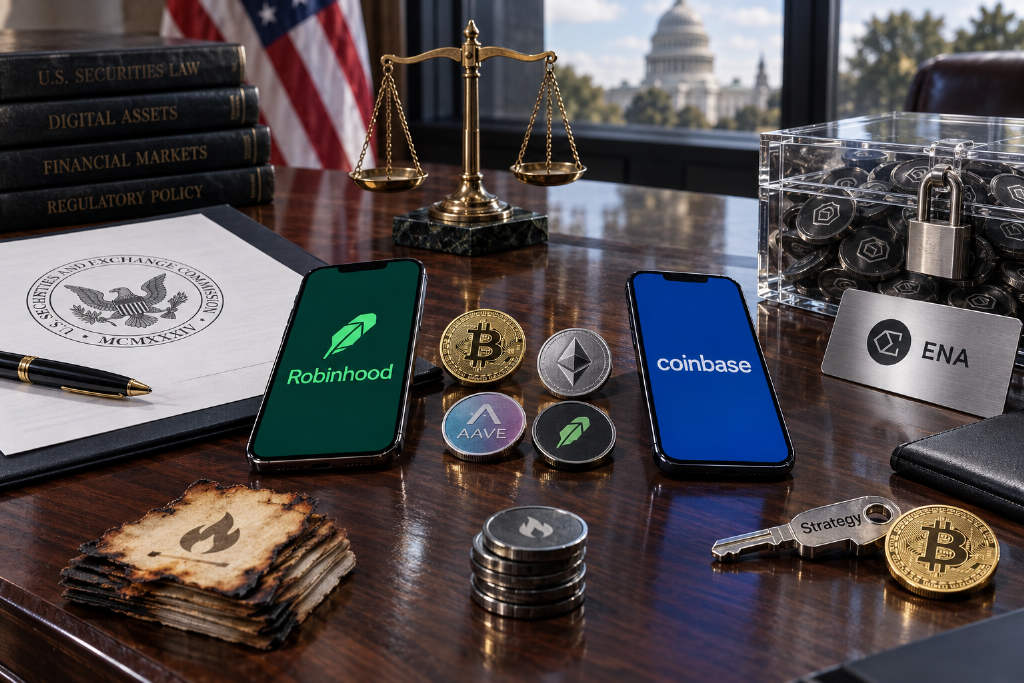
ChainFeeds2026-10-01 02:28:11Robinhood Presses Coinbase as Token Buybacks and SEC Policy Shift Reshape Crypto DebateChainFeeds’ Oct. 1 research digest pulled together five separate but connected conversations now shaping crypto markets. One thread focused on Robinhood’s push beyond brokerage into onchain finance, where Robinhood Chain, event contracts and tokenized stocks are putting pressure on several of Coinbase’s core businesses at once. Another examined token buybacks through the examples of AAVE and Pump.fun, arguing that the destination of repurchased tokens matters as much as the buyback itself: treasury retention, staking redistribution, reserve allocation and permanent burns do not carry the same implications for supply. The digest also highlighted Jeff Dorman’s argument that a softer stance from the U.S. Securities and Exchange Commission has reopened a question the market had long avoided under legal pressure: whether crypto tokens should capture real economic value from the protocols they represent. Michael Saylor’s latest explanation of Strategy’s “digital credit” model, built on a single balance sheet spanning bitcoin, dollars, debt, preferred stock and common equity, rounded out the institutional side of the report. The final section turned to Ethena and ENA, where buyback expectations are colliding with a scheduled Oct. 5 unlock of 1.4 billion tokens.40
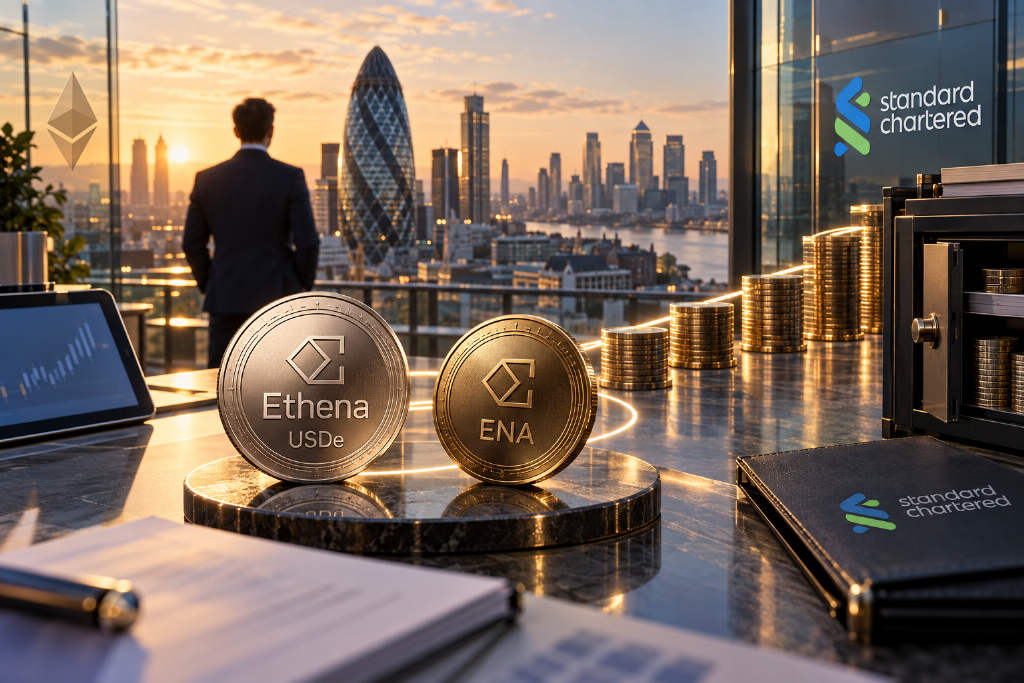
Standard Char2026-09-30 20:57:32Standard Chartered projects Ethena’s USDe at $40 billion by 2028, with ENA seen at $2Standard Chartered has started coverage on Ethena’s ENA token and says the protocol’s USDe stablecoin could expand to $40 billion in supply by the end of 2028. In a research report shared with Cointelegraph on Wednesday, the bank set a year-end 2028 target of $2 for ENA, about seven times the $0.28 reference price cited in the note. It also said USDe could grow slightly faster than the broader stablecoin market over the same period. The bank’s thesis rests on Ethena broadening its yield sources beyond the crypto basis trade that has historically supported USDe. Standard Chartered said lower returns from the strategy of holding spot crypto while shorting perpetual futures have pushed Ethena toward DeFi, institutional lending, real-world assets, and basis trades linked to equities and commodities. Those activities currently produce a blended yield of 5.2%, according to the report. A second pillar of the bank’s view is ENA buybacks. Standard Chartered said a fee switch approved by Ethena governance in early September directs 95% of net revenue from business lines to ENA buybacks once USDe reaches certain supply thresholds. The bank argues that if USDe scales as projected, buybacks could become large enough to support a higher ENA valuation.70
SEC2026-09-30 12:12:12SEC narrows token buyback relief to crypto networks with no central partyThe U.S. Securities and Exchange Commission has sharply narrowed what at first looked like a broad opening for token buyback programs. In an FAQ published on Sept. 25, SEC staff initially said that once a crypto network is functional, announcing a token buyback would not by itself amount to a promise of essential managerial efforts under securities law. Markets read that as a positive sign for revenue-generating protocols that buy back and burn tokens, and Pump.fun’s PUMP rose about 10% the next day. That reading did not last. After criticism from legal experts, the SEC staff revised the language on Sept. 28 to say the position applies only where a crypto system is functional and has no central party. The agency had already defined a central party in a March interpretive release as any person, entity, or group with operational, economic, or voting control of a crypto system. According to Unchained, this change leaves many prominent buyback programs outside the FAQ’s protection. Hyperliquid comes closest because its buybacks run automatically, but validators operated by its foundation hold nearly half of the network’s votes. Other programs mentioned in the analysis, including PUMP, JUP, LINK, AAVE, SKY and LDO, are tied to companies, committees or token-holder governance structures, leaving them in the same case-by-case Howey test limbo rather than inside a clear safe harbor.40
Altcoins2026-09-30 07:31:01Altcoin Rally Shifts Toward Revenue-Generating Protocols as Privacy Coins Surge and Buybacks Gain TractionA TechFlowPost-translated market analysis argues that the current altcoin rally looks different from prior cycles: capital is no longer chasing meme tokens indiscriminately and is moving instead toward protocols with visible utility, recurring revenue, and token buyback mechanisms. The report highlights privacy coins, meme coin launch platforms, lending markets, and decentralized exchanges as the main areas drawing attention. Zcash is presented as a leading privacy trade, with a 218% year-to-date return. The article says shielded supply rose to just above 30% of total ZEC supply, while shielded transactions accounted for 52% of Zcash transaction volume, with usage accelerating in August 2026. On the derivatives side, ZEC futures open interest, after breaking above $300 million before 2026, has climbed past $2 billion following a reversal tied to negative funding rates. The piece also draws a contrast inside the meme coin segment. While PUMP is up 134% year to date and users have gravitated toward Pump.fun on Solana and Pons on Robinhood Chain, the MSCI Datonomy meme coin sub-sector still shows a median loss of 27% for the year. Meanwhile, protocols such as Aave, Uniswap, and Hyperliquid are being watched for their ability to monetize services and direct revenue back to token holders. Aave is projected to generate about $47 million in annualized revenue from its Ethereum lending markets, and Uniswap has already burned more than $12 million worth of UNI on Ethereum, according to the report.280
SEC2026-09-30 06:46:43SEC staff FAQ on crypto draws lines around buybacks, staking receipt tokens and post-launch network workThe U.S. Securities and Exchange Commission’s Division of Corporation Finance released a crypto asset FAQ on Sept. 25 that applies the agency’s March framework to several contested scenarios: token buybacks, staking receipt tokens, post-launch development on functional networks, and whether secondary trading platforms can be treated as promoters. The document says the answers reflect staff views only, not formal SEC rules, regulations, or Commission statements, and that the guidance carries no legal force. Still, the FAQ gives the market a clearer picture of what staff will examine when deciding whether an investment contract relationship still exists. The main dividing line is whether a network is already functional. In that setting, a buyback announcement for a non-security crypto asset does not amount to a promise of essential managerial efforts, according to the staff. If the network is not yet functional and the issuer frames the buyback as a way to generate returns for token holders, the analysis can shift. The FAQ also sets a narrow definition for staking receipt tokens, says maintenance and upgrades on a functional network do not fall on the managerial-efforts side of Howey, and states that secondary-market platforms are not promoters unless they meet the existing Rule 405 definition. The result is a framework that puts unusual weight on timing, facts, and issuer language.260
Aave2026-09-30 02:32:05AAVE Burn Talk Lifts Price, but Buybacks Still Depend on Where the Tokens End UpAave founder Stani Kulechov said on Sept. 29 that the team is considering adding a token burn mechanism to Aavenomics 3.0, helping push AAVE up more than 11% in a day. On the same day, Pump.fun’s automated contract kept using 50% of platform revenue to buy PUMP on the open market and burn it permanently. The comparison highlights a core issue in crypto buyback narratives: buying tokens back is only the first step, and the real impact depends on what happens next. The article breaks token buybacks into four broad outcomes: treasury storage, permanent burns, transfers into designated reserves, and redistribution to stakers. It then contrasts Aave, where more than 205,000 AAVE bought back through early 2026 were placed into the Ecosystem Reserve rather than destroyed, with Pump.fun, which burned roughly $370 million worth of PUMP on April 28, 2026, equal to 36% of circulating supply. Despite that, PUMP remained far below both its launch price and all-time high. Hyperliquid offers a different case. Its Assistance Fund uses 97% to 99% of protocol trading fees to buy HYPE, and validators recognized those holdings as permanently burned in December 2025. By September 2026, about 48.42 million HYPE had been removed from supply. The piece argues that buybacks matter most when they are funded by real revenue, reduce net supply, and support a token that already has clear utility.230
SEC2026-09-29 10:01:00SEC Staff Tighten Token Buyback Guidance, Limiting It to Functional Networks With No Central PartyThe U.S. Securities and Exchange Commission’s Division of Corporation Finance revised its crypto FAQ on Sept. 28, narrowing recently issued guidance on token buybacks just three days after first publishing it. The updated answer now applies only where a crypto network is both functional and has no central party. Under the revised staff view, an issuer’s announcement of a buyback program for a non-security crypto asset would not, in that setting, amount to a representation or promise to undertake essential managerial efforts — a factor that can turn a token sale into an investment contract under the Howey test. The rest of the answer was left unchanged. Staff also maintained that on a network that is not yet functional, a buyback announcement could still be treated as such a promise if the issuer presents the program as creating yield or return for token holders. The revision drew praise from a16z crypto’s Miles Jennings, who had criticized the earlier wording. The FAQ, however, reflects staff views only and does not carry legal force or effect, according to the division.180